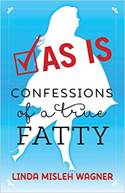
My guest today is Linda Misleh Wagner who has written about her battle with food and weight. It’s a compelling story that will capture your attention. Hi, Linda, thanks for coming on my blog to talk about your book, AS IS: Confessions of a True Fatty. Let’s get started.
As long as she can remember, Linda Misleh Wagner’s life has revolved around food. Her parents and uncles owned neighborhood grocery stores where the children in the family could claim countless treats. Family gatherings were centered around the wonderful ethnic dishes they had brought with them from their homeland and the new specialties they developed as Americans. And, of course, there were the treats. Skin a knee or get a good grade, the treats were the same: food. The message was clear. Food made everything better. So, as with so many of us, Linda became addicted to food. Whenever life’s vicissitudes hit – and they hit her often – she turned to food for comfort, eventually topping out at 415 pounds on her 5’6” frame.
B ariatric surgery cured the type 2 diabetes and high blood pressure and cholesterol that plagued her, and Linda lost 250 pounds. With her doctor assuring her that she had twenty pounds of loose skin, in reality she was down to 145. But while the physical was addressed with the surgery, what had driven her to obesity was not, and five years post-surgery food once again became her drug of choice with Linda going back up to 315. She had joined the 95% of people who don’t keep the weight off.
Linda’s personal story is both moving and compelling. And because it touches on our power to persevere, it is universal. In writing AS IS, Linda sought the reasons for her dependence on food. But while the particular story is hers, the experience is one shared with the more than 60% of Americans who are overweight – more than half of whom are obese. And in the writing, Linda began her journey to becoming a Future Former Fatty, inviting others to join her quest for health.
With her signature humor, honesty, and intelligent insight, Linda has answered some questions for us.
More than 60 percent of Americans are overweight. What do you believe are the three most compelling reasons for this?Food tastes good. Food is so yummy that it is almost an erotic experience for most of us. Many of us would rather eat than have sex. When we eat, we are not thinking about how we look naked in front of someone else. We just eat and enjoy.
- A party is not a party without good food. Food is very social, and brings people together. Be it a celebration or a funeral, our society centers around food. It is the socialization of food that proclaims to others “I care about you. I love you. I want to comfort you”. Most people, no matter their size, love to eat and look forward to their next meal. Stand still in a group of people and listen. Usually the topic is about something fantastic they ate at a restaurant followed by how much weight they need to lose.
- Right or wrong, food fulfills emotional needs. Hence comfort foods, pig out parties, last hurrah. We all tend to feel better after we indulge in foods we know will lift our spirits. Heck, I have had many a food high.
Statistics show that only around five percent of people who lose weight keep it off? Why do you think the success rate is so low?
The reason why the rate is so low when it comes to keeping weight off is because the addiction of food is like no other type of addiction. We need food to survive. And if we are a food addict and an emotional basket case from time to time, the first thing any of us will do is reach for the cookie that we remember mommy offered to us when we were children and had a scraped knee or a bad day. Eating is needed to live, and is habitual. It’s too hard to change ingrained habits.
A lot of attention is given to anorexia and bulimia as illnesses, but very few people speak of obesity with such considered concern. Why do you think society is more understanding of anorexia and bulimia than it is of obesity?
Unfortunately, people see obesity as a lack of will-power and self-discipline. Most people who have never had a weight problem cannot comprehend that obesity is just as much as a disease as anorexia and bulimia. The problem is in our heads whether we suffer from obesity, anorexia, or bulimia.
To what would you ascribe your problems with weight?
Oh boy! Cry me a river. Really, I am an emotional eater. I stuff my feelings of anger, inadequacy, hurt. Name it, and I stuff it down. I like my world pretty, meaning kind, nice, respectful. When I feel like things our out of sorts in my life, my drug of choice is sugar.
You finally succumbed to bariatric surgery. What are the pluses of having had it?
I am so grateful I had bariatric surgery. Even though I am once again fat, I was one hundred and thirty-five pounds heavier than I am now before the surgery. But post-surgery and initial weight loss, no more diabetes, blood pressure is so much better, and I had so much energy. I felt good about myself. I could shop anywhere I wanted and wear shoes with a heel without worrying about falling on my duff. And most importantly, my surgeon and doctor told me I was truly healthy.
What are the drawbacks?
You can’t eat. And when you can begin to add foods back into your diet, it is very easy to go down the slippery slope of reverting to old habits.
I also have trouble absorbing nutrients. I tend to be very anemic, and I get dehydrated very easily.
You regained about half the weight you lost. Why?
The surgery is only a tool. People think that having bariatric surgery is “taking the easy way out”. It is not. Rearranging your organs to lose weight takes a lot of guts – and the rearranging of those guts.
I regained half my weight back because I reverted to the familiar habits I had prior to surgery when I was hit with the first devastating life shocker. Unfortunately, most bariatric patients will regain about fifty percent of their weight back.
The multi-billion diet and exercise industry in this country is a failure. Why?
Because the problem is not about dieting and exercise. These things are solutions. We have to address the real problem. And that problem that needs to be fixed is a problem that no diet plan or exercise routine or surgery will resolve. The solution is to fix what’s between the ears.
Whatever the issues in our lives, we have to change the relationship we have with food and truly fight the demons that call our name. Funny, but it is kind of like your first boyfriend. You decide to save yourself for marriage, but he is just so dog-gone cute. It’s hard to say no. The same goes for food. If you have a bad relationship with food, it’s hard to resist. If you have a good relationship with food, you are healthy. Simple as that.
The diet and exercise industry promises to fix the outside when it is the inside that needs fixing.
What does it really take to reclaim a healthy lifestyle? And how would you define that lifestyle?
Commitment, kindness to self, and a desire to live far better than we are living now. Making a commitment to one’s self is so difficult. It is easy to let ourselves down and deal with the consequences. Denial is powerful.
We have to stop being so hard on ourselves. We are not failures if we struggle to get a grip on our weight. We have a true medical problem. We need to start treating obesity as a disease. If we had a serious medical issue such as diabetes or heart problems, we wouldn’t hesitate to take the medicine needed to keep us healthier.
The same goes for obesity. We need to realize that a weight problem needs medical attention as much as any other disease. Let’s face it. Obesity leads to diabetes, heart problems, and so many other diseases. Therefore, it is a disease with consequences like any other disease.
You are once again on a weight-loss track. What will make this time successful for you?
I am going to be real honest with you. I don’t know if this time I will be successful. I can only say that I really am trying to eat better, make better choices, move more, and take better care of myself. If the result is I lose weight and get healthy, then my day-to-day choices will make this time successful.
I don’t care about how fast I lose weight. I care more that I am aware of what I am doing to myself when I don’t eat right. Once we are aware, we are more likely to think twice before succumbing to anything that will do us harm. And make no mistake, eating poorly is something we all need to be very aware of and change. Successful weight loss is a byproduct of making a commitment and following through with taking care of ourselves.
What are your three top bits of advice for beating the cheat?
- Talk yourself out of it! Remind yourself how well you are doing and why you are working to lose weight. When we start to feel better about ourselves, we tend to forget the reasons why we know we need to lose weight.
- Get yourself away from whatever food is calling your name. Then stop. Breathe in and out a few times. And then ask yourself, why do I feel like cheating? Is it worth it, or will it only serve to make me feel guilty and bad about myself. If you are in the house, go take a walk. No money or debit/credit cards. It is too easy to give in to fast foods.
- Call a friend. If you have a good support team than can talk you out of it, then If you don’t have someone to talk you out of cheating, then beat the cheat by calling a friend and talking or go meet for a cup of tea or coffee. The cravings will go away after about twenty-minutes.
AS IS is not a diet book, it is a memoir. Who do you see as your primary audience?
Anyone who has ever had a weight problem, be it obesity, anorexia, bulimia. Food addiction is addiction, no matter what end of the spectrum you are at.
I know people who have never had food issues, but have family, friends, children who may have weight problems and they want to understand them better and find ways to help them. My book is relatable. There isn’t anyone who will not relate to everything I share, and trust me, I tell all my nitty gritty truths.
No matter what a person’s problems, if it has anything to do with food people will see themselves in my story, they will relate, and they will find they are not alone. We all are confronted with many different and painful life situations. As you read AS IS, you will learn I have had more than my share. With that said, somewhere deep down inside, when we must deal with difficult times, we find an inner strength to survive and overcome no matter what. There is something amazing and resilient in knowing this.
Why did you write AS IS?
At first, I thought to write a book that made fun of being obese yet with a very clear message that obesity is really not funny. It is serious. Sometimes it is easier to bring to light serious topics through humor.
But when pushed by my editor, Mark Clements, to dig deeper and get into the reality of my obesity, I found I needed to explore how the effects of obesity have contributed to my life and have been affected by my life.
It was time to bring to light the reality of the disease of obesity. It is not about a lack of will-power. If it was, it would be so easy to solve our weight problems. It is not that we don’t have the self-discipline to just push the plate away. It is because we can’t push the plate away because there is an addiction problem that needs to be addressed.
What do you hope readers take away from reading your book?
I hope readers will see themselves in my story, and that they will know they are not alone. They are not failures. That others share the same struggles as they do.
I hope readers recognize that as long as we keep fighting to be healthy, we will eventually succeed and do better than we were doing before. I may have gained some of my weight back after bariatric surgery, but I gained less than half of what I lost, and I have not gained weight since I began this new journey. Instead, I have begun to lose weight again.
If I can do it, my readers will be inspired and know they can too. We unite and work to go from future former fatties to former fatties. We can and will do this together.
Thanks, Linda. Your book is a topic that many Americans struggle with, I’m sure your insight will be a big help to those who may have lost hope.









 John M. Wills