It sometimes unnerves me when people read my Black Horse Campground murder mysteries and ask if they’re based on true stories. If I knew that many murder victims (and, by extension, murderers), I would probably never leave my house!
The reason the question pops up so frequently is because I incorporate a lot of actual places in my stories. Locals who have read the BHC mysteries know exactly where the campground is located—even though it doesn’t exist—due to all the real-life towns and businesses I use to set the scene and give the stories a more true-to-life flavor.
In a way, it’s almost cheating to have real-life locales as the setting for a story. After all, you just have to visit the places to get the descriptions and “vibe” just right for the story, with actual details that make it ring true. But you have to know and even love the story’s setting in order to make it ring true, just as you have to know and love the characters to make them sound like real people.
In my fourth book, At the Crossroad, setting plays a major role in the story and mystery. J.D. Wilder, the newcomer from Houston, TX, is beginning to feel at home in Bonney County and develops a fierce sense of protectiveness of the place and people who inhabit it. Here is the blurb and a short excerpt: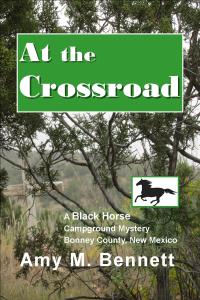
Trouble often comes in threes. It’s no different at the Black Horse Campground.
On his first day as detective with the Bonney Police Department, J.D. Wilder finds three cold case files on his desk—three women who have disappeared over a fifteen year period at five-year intervals. It seems that no one has ever taken the cases seriously… or even properly investigated them.
Then J.D. receives a visit from two former colleagues who inform him that he’s about to receive another visitor; a woman from his past who is in trouble and needs his help. Again. The timing couldn’t be worse, since he’s finally about to ask Corrie on a date, but then Corrie also has a visitor from her past show up… someone who’s hoping for a second chance with her. In the meantime, Sheriff Rick Sutton has his hands full dodging his ex-wife, Meghan, who insists on discussing personal business with him… business that has to do with digging up a painful past.
When three bodies are discovered that prove the missing women were murdered, J.D.’s investigation reveals that all of their visitors have some connection to the victims. But which one of them killed three women… and is prepared to kill again?
When trouble comes to Bonney County, Corrie, Rick, and J.D. band together to protect each other and their community. But can they solve the mystery before the murderer strikes again?
Excerpt from Chapter 14
J.D. returned to the Black Horse more wide awake than he had been in days. Amato’s words rang in his ears, while a voice in his head warned him that if he didn’t get some rest, he was going to be completely useless when the time came to have his wits about him and his energy. Still, a night spent in mostly inactivity wasn’t going to allow him to rest. He went into his cabin and changed into his running clothes. He needed to release some tension and energy if he was going to rest at all.
He slipped out of the cabin, casting a glance toward the campground store. It was almost six thirty a.m. and Corrie’s apartment light was on but the store’s lights were still out. He had missed the Friday night fish fry dinner, but he hoped to be back once she was open and be able to talk to her more. And get a decent breakfast.
He started out, following the path he’d taken a couple of days earlier. The cool morning air was amazingly refreshing, helping clear his mind while invigorating and relaxing him at the same time. His breathing eased as his strides became more purposeful. He was near a breakthrough in the cold cases. He could feel it. Officer Amato had information that could help reveal the truth about what happened to the three women. After that… he’d have to wait and see.
He rounded the curve where he had seen the small cemetery the last time he had run this path and he slowed to a stop. He had pushed it to the back of his mind and had all but forgotten about it until this moment. Now was as good a time as any to pay his respects. His run had already accomplished its purpose. He knew he’d be able to sleep when he got to his cabin and he’d probably stroll back to the campground after this. He allowed himself a grin as he left the path, picking his way through the tall grass and brush to where the grave sites were.
Unlike most small cemeteries he’d encountered, there was no fence surrounding this one. In fact, there were only three wooden markers, crosses, all of them uniform but in different stages of weathering. He stopped when he got close enough to make out the lettering and suddenly the breath rushed out of him, leaving him feeling weak and dizzy with shock.
The first marker, the most faded, bore the name Carla Sandoval. The second, Rosalie Edwards. The third, the one with the least amount of weathering and the least faded lettering, read Benita Rojas.
Beside the one for Benita Rojas was an open grave. A plain wooden cross lay nearby. Both looked recent. Only a few days recent.
J.D. stumbled back, afraid that his eyes were playing tricks. He fumbled for his cell phone and let out an expletive when he realized he’d left it in his cabin when he changed his clothes. He reached the path and took off at a dead run back to the Black Horse Campground.
He’d been right; there had been more to the disappearances than what was common knowledge.
He hated it when he was right.
Author Bio
Amy Bennett’s debut mystery novel, End of the Road, started as a National Novel Writing Month project in 2009. It went on to win the 2012 Dark Oak Mystery Contest and launched the Black Horse Campground mystery series, followed by No Lifeguard on Duty and No Vacancy, which have both been awarded the Catholic Writers Guild Seal of Approval. At the Cross Road is the fourth book in the series.
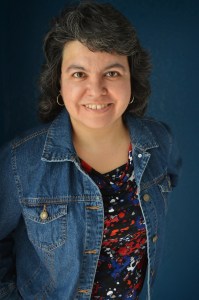 When not sitting at the laptop actively writing, she works full-time at Walmart of Alamogordo (not too far down the road from fictional Bonney County) as a cake decorator and part-time at Noisy Water Winery in Ruidoso (where you can find some of the best wines in the state of New Mexico, including Jo Mamma’s White!) She lives with her husband and son in a small town halfway between Alamogordo and Ruidoso. Visit her website at and The Back Deck Blog at http://amymbennettbooks.blogspot.com

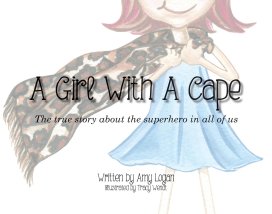
 The cape, which is included with
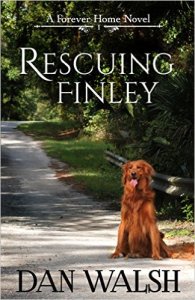 Rescuing Finley is a refreshing, comfortable story, one that leaves the reader with a good feeling about society and the inherent goodness in people. Chris Seger, a former Marine, lost a leg while serving his country in Afghanistan. But he suffered more than just physical pain—he developed PTSD—a condition that interferes with his ability to interact with people in a normal manner.
 John M. Wills